
SUICIDE PREVENTION: LET’S CHANGE THE CONVERSATION
Understanding what lies behind the words
Written from lived experience | 17 September 2026
September brings a focus on suicide awareness, with World Suicide Prevention Day observed annually on 10 September. This year’s theme is “Changing the Narrative on Suicide”, with the call to action: Start the Conversation.
Suicide prevention begins with creating a space where someone feels safe enough to say, “I’m thinking about suicide.” That means being willing to ask the difficult question: “Have you ever thought about suicide?” But it also means being prepared to hear the answer.
That includes whether someone feels safe enough to say, “I’m struggling.” “I can’t do this anymore.” “I’m hurting.” “I don’t know how to live with this.”
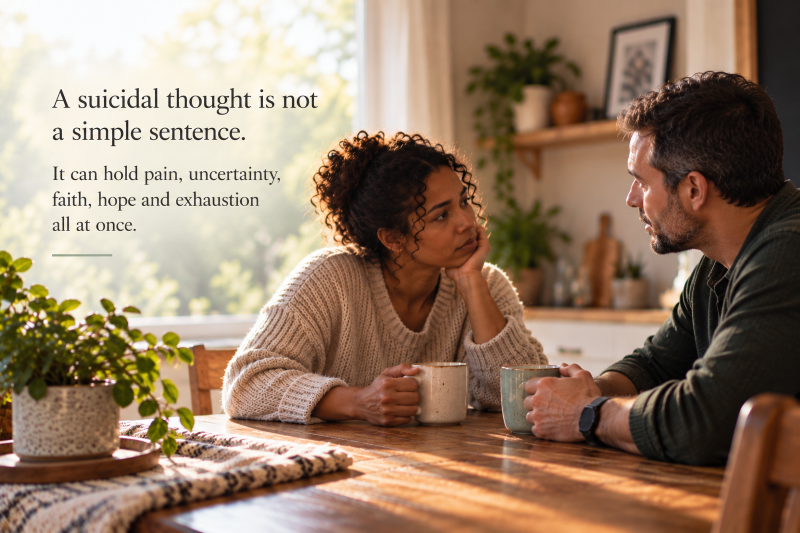
For the person experiencing suicidal thoughts, the experience can be complex. They may feel overwhelmed by thoughts of death without having a specific plan or have considered a method while remaining uncertain about whether they will act on it. Their experience can change from one moment to the next.
Yet suicidal thoughts are easily misunderstood. Their words may be dismissed as attention-seeking, manipulation or selfishness, when they may actually be an expression of intense emotional pain. These assumptions can make it harder for someone to speak honestly or ask for help.
For me, faith is also part of this conversation. Having suicidal thoughts has never meant that I have lost my faith. I can struggle intensely while still feeling deeply connected to God. I can pray through the pain, ask questions, ask for things to get better, plead with God while also asking God to help me die.
Faith and suicidal thoughts can exist in the same person at the same time.
Hope can also be complicated. I once wrote:
“It’s hard carrying everyone else’s hope while you’re quietly losing your own.”
By “losing my own”, I meant losing the hope I once had for my future: that things could get better, life could change, and I could feel differently. When you can no longer see the future others want you to believe in, being told that things will get better can become another burden. But losing that hope does not mean losing hope altogether. Hope can change direction. Sometimes, it becomes a hope simply for an end to the pain. That, too, is hope.
This is why changing the narrative matters. Suicide prevention is not only about teaching people to reach out. It is also about understanding what may be happening inside the person who does.
When someone finally speaks, we may not know what to say. We may want to fix, reassure or make the pain disappear. Sometimes the most important thing we can do first is listen.
Starting the conversation matters. So does learning how to hear what is actually being said.